Online tire store, Vilnius, Lithuania
An online store with 13,828 tires, filled by the supplier feed
UAB Transratai has sold tires since 2008, mostly to auto repair shops and businesses. The online store had to sell the same tires from the same warehouse in Vilnius, with one condition: nobody would type in thousands of products by hand or update stock counts. It needed a store filled by the feed from the company's accounting system, not by a person, and one that keeps itself up to date.
Open padangos.online (in Lithuanian)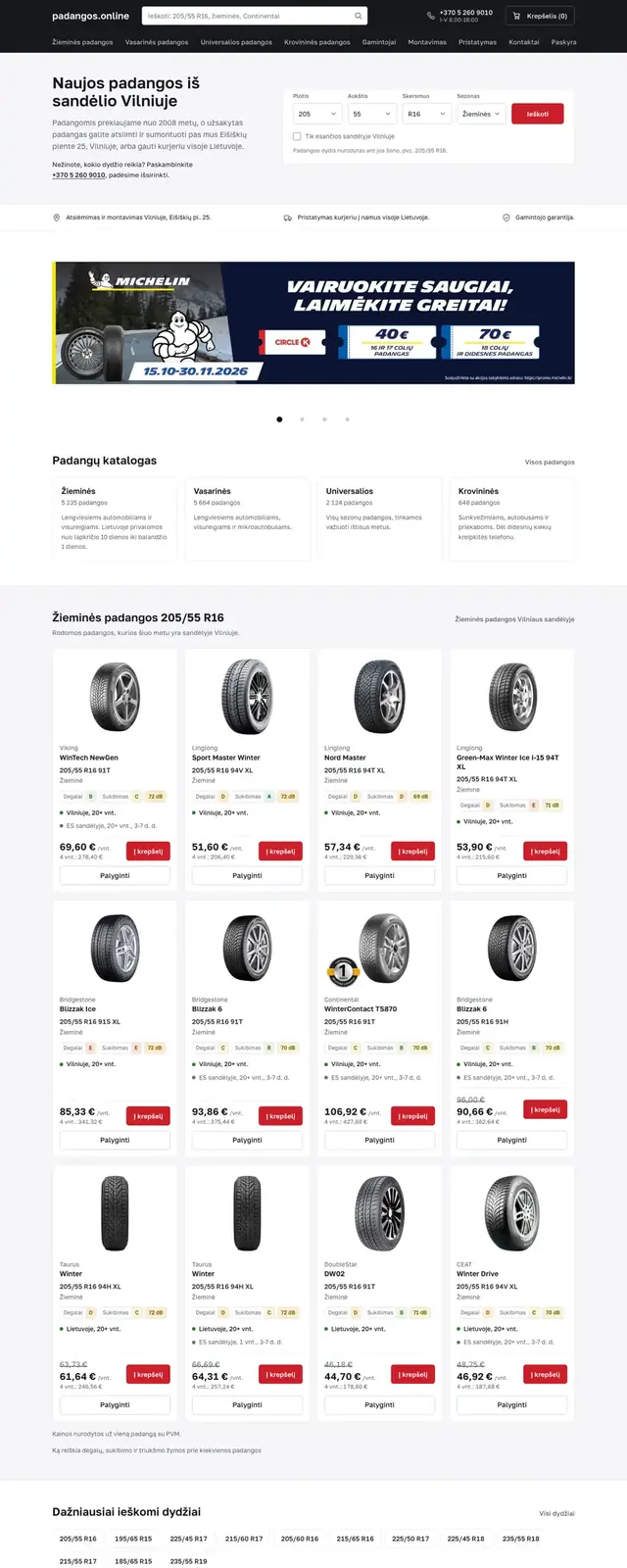 padangos.online
- Live site
- padangos.online
- Tires in the catalog
- 13,828 (October 20, 2026)
- Brands
- 60
- Selling tires since
- 2008
- From feed analysis to launch
- 18 days
Before: the stock lived in the accounting system
UAB Transratai is a tire wholesaler at Eišiškių plentas 25 in Vilnius, selling since 2008, with its own warehouse and a tire fitting shop at the same address. Until now its main buyers were auto repair shops and businesses. The new store had to offer the same tires to private buyers too, and the old website showed only part of what was really in the warehouses. All the product information lives in the company's accounting system and goes out as an XML feed: products, prices, and stock in the Vilnius warehouse and in a European warehouse. When we studied that feed we found what we find in every supplier feed: the same product code on two lines, some photo links dead, about a quarter of the products without EU label values, and barcodes usable for only about half. The store had to live with that, not wait for the data to be perfect. On the buyer's side there was one requirement. People know only the size printed on the tire's sidewall, and they need to see within seconds what is in stock, what a set of four costs and when it will arrive. Then there is the law: the EU tire label has to sit next to the price, online too, and a discount has to show the lowest price of the previous 30 days.
What we built
The store runs on WordPress and WooCommerce on its own server, with Redis and a page cache. Thousands of products with an automatic import, custom filters, clean addresses and Lithuanian delivery and payment methods need full control on the server side, and a rented platform either limits that or charges per product.
- An import from the supplier feed instead of manual entry. The feed comes from Rivilė, the company's accounting system, and is read automatically. Products are merged by code so the same tire never appears twice, and prices and stock in both warehouses update without a person. When a tire runs out in the warehouse, the store finds out by itself.
- Search by size, and filters with live counts. Width, aspect ratio, rim size and season are on the first screen. In the catalog you can filter by warehouse, brand, price, label class, load and speed index, carmaker approval, run flat, XL and studs, and each filter shows how many tires will be left if you pick it.
- Stock location and delivery time before you order. Every tire says whether it is in Vilnius, in another warehouse in Lithuania or in an EU warehouse, and how many working days it will take. From the EU warehouse that is 3 to 7 working days. Buyers know the timing before they pay, not after.
- Pick 1, 2 or 4 tires and the price for the set updates at once. Below the price: free pickup in Vilnius, courier delivery at a fixed fee per tire, and fitting on site. Payment is cash or card at pickup or to the courier, or a bank transfer against an invoice issued in advance.
- Clean addresses for catalog pages. Season, brand, size and their combinations have addresses without parameters, such as /padangos/sezonas/ziemines/ for winter tires and /padangos/dydis/205-55-r16/ for one size. Google indexes those as real pages, and the old addresses with parameters still work and point to the new ones with a canonical tag.
- The EU label, EPREL and what the sidewall markings mean. Every tire shows its fuel efficiency, wet grip and noise classes with a link to its official sheet in EPREL, the EU's product database, and a separate section explains that tire's markings: load and speed index, sidewall height, overall diameter. It is what a salesperson explains at the counter.
- Delivery, payment and legal pages written from scratch. We wrote the delivery, payment, warranty, returns, terms of sale and labeling pages ourselves, based on how the company really works. For discounts the store keeps a 30-day price history, so every crossed-out price follows the EU rule.
- Up to four tires side by side in a comparison, and reviews that are moderated before they appear.
How it went, step by step
- September 4, 2026: feed analysis and plan. We studied the supplier feed overnight: duplicates, photos, labels and pricing logic. The whole build plan was written from that.
- September 10: the client first saw a working store with the real catalog, at a test address.
- September 18: the order chain. Order emails from info@padangos.online, an invoice in advance for bank transfers, a “ready for pickup” status, and the information pages.
- September 22: launch. The domain was switched, the block on search engines came off, the sitemap went to Google, and a real purchase on a phone went through. Google showed the store the same day.
- September 23: we went through the store on a phone and wrote down 16 points, among them the sticky header, the cart, the coupon at checkout and city suggestions. All were fixed the same day.
- September 24: five articles, on tire pressure, the DOT date code, storing tires between seasons, studs, and mandatory winter tires.
How it works now
The store is live at padangos.online, in Lithuanian. On October 20, 2026 it had 13,828 tires from 60 brands in four categories (winter, summer, all-season, and van and truck), with catalog pages by season, brand and size that open straight from Google. The count changes every day with the supplier feed. Giedrius Vievesis from Transratai wrote to us in an email, quoted here with his OK: “Really great. You're geniuses nobody has heard of yet.” What isn't finished: not one link from the company's old site, transratai.lt, leads to the new store yet. That would be the strongest free signal to Google this store could get, and it is in the client's hands.
Check it yourself
- Open padangos.online and enter the size 205/55 R16. The results should show the warehouse status next to each tire and a price for the set.
- Open padangos.online/padangos/sezonas/ziemines/ (winter tires). The top of the page says how many tires are in the category, and the filter counts change when you pick a warehouse or a brand. The total changes daily with the supplier feed.
- Open padangos.online/gamintojai/ (the brands) and count them. On October 20, 2026 there were 60.
- On a tire's page, below the price, you'll find the EU label with a link to EPREL. It takes you to the official EU product sheet, not to a page of ours.
What other online stores can take from this
- A system should fill the catalog, not a person. When there are thousands of products and stock changes every day, manual entry loses in the first week. The store has to read the same feed the accounting uses, and switch off by itself whatever is no longer in the warehouse.
- Supplier data is never clean. Duplicates, dead photo links, missing labels and barcodes are the norm, not the exception. Study the feed before you build, not after, and build the store to work with the data as it is.
- Delivery time before the order is a selling point. A buyer who sees “Vilnius, 20+ in stock” or “EU warehouse, 3 to 7 working days” before adding to the cart orders with less worry and calls less often to ask where the order is. A status next to the product is the cheapest customer service there is.
- The law is part of the design. The EU tire label next to the price and the 30-day rule for discounts are not a lawyer's add-on at the end. If they are built into the store from the start, whoever runs it never has to think about them.
What we don't show here
We will never show orders, revenue or conversion rates: under the contract those are the client's confidential data. Search Console is connected to the store, but it went live on September 22, 2026, too recently for a traffic curve to mean anything.
Want the same for your business?
We build the first version free, in 2 days. You click around it, then decide. If it is not for you, you owe nothing.