Law firm, Vilnius, Lithuania
A law firm website that convinces by promising nothing
In legal services almost every firm writes the same words: professionalism, experience, individual attention. A client with a serious problem has stopped reading them. They want to know whether the firm handles cases like theirs, who exactly will advise them, and what happens next. A site that promises nothing and simply answers those three questions convinces more than any line about professionalism.
Open morkunas.eu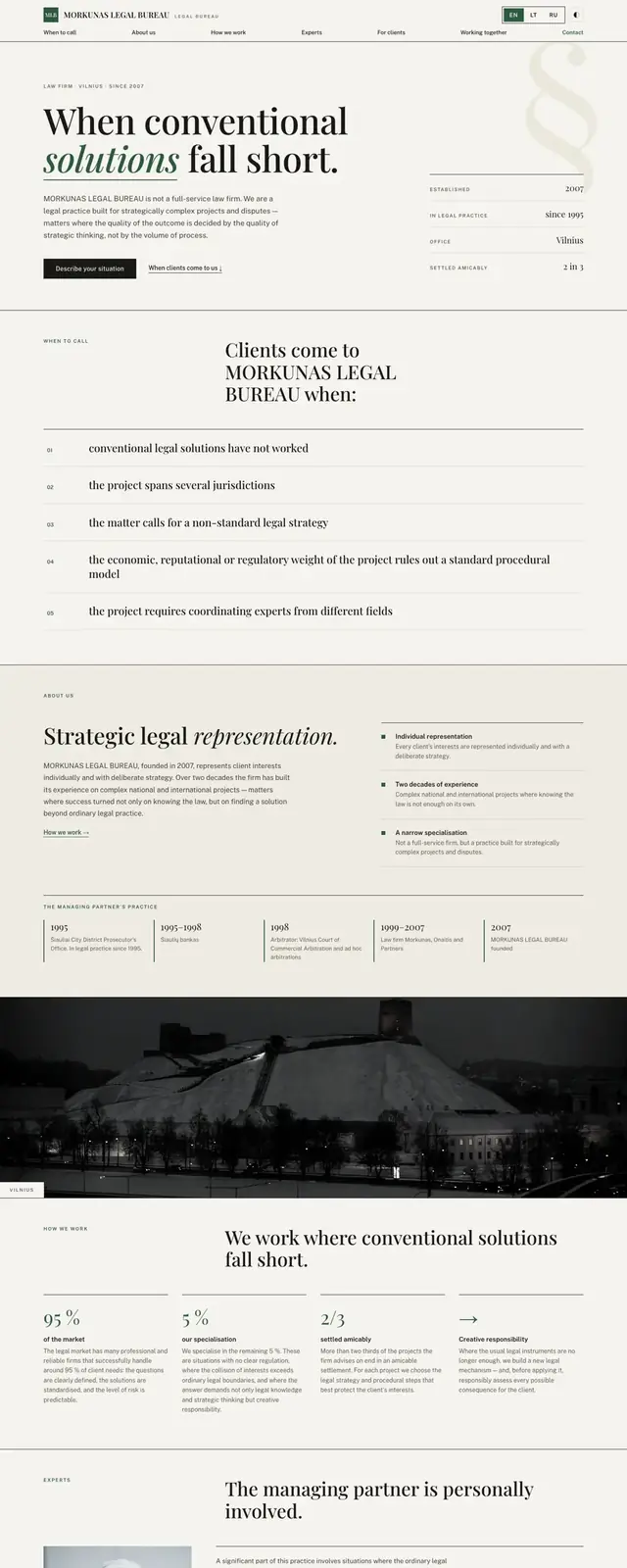 morkunas.eu
- Live site
- morkunas.eu
- Languages
- English, Lithuanian and Russian, each at its own address
- Firm founded
- 2007
- Lawyer in practice since
- 1995
- Tracking cookies
- None, and no analytics
Before: a broken site in a field where everyone sounds the same
Morkūnas Legal Bureau is a Vilnius law firm, founded in 2007, that works on strategically complex projects and disputes. It is not a full-service firm. It deliberately doesn't take everything, and that is the core of how it presents itself. A client of a practice like this arrives quietly and with a serious problem. A standard law firm website answers their three questions with the same lines about professionalism that everyone writes, so it answers nothing. In law, a sales tone also works in reverse: exclamation marks, promises to win and rounded success rates raise suspicion instead of trust, and the profession's ethics rules don't favor that kind of advertising anyway. On top of that, the firm's old site at morkunas.eu was broken. Instead of a page it showed raw server code, the security certificate didn't match the domain, and nobody had told the firm. That is why they got in touch. The client read the website like a case file: before the first version, he sent us a six-page technical brief with requirements on ownership, access and warranty.
What we built
A site that is informational at its core, not out of caution. Each language version is one page with seven sections, plus its own privacy policy: six pages in all.
- A first screen that says when to come to this firm, instead of saying it is professional: “When conventional solutions fall short.” Below it, a section lists the situations in which clients come to the firm, so a visitor knows within seconds whether they are in the right place. Next to the headline sit four facts that can be checked, in the firm's own words: founded in 2007, in legal practice since 1995, office in Vilnius, 2 in 3 matters settled amicably.
- Experience as dates, not adjectives. The managing partner's path is a timeline: a city prosecutor's office in 1995, a bank from 1995 to 1998, practice as an arbitrator from 1998, an earlier firm from 1999 to 2007, then this one. Dates can be checked, so they carry more weight than “extensive experience”.
- Three full language versions. English at the main address, Lithuanian at /lt/ and Russian at /ru/, each with its own privacy policy and its own PDF. The address decides the language, not a browser guess, so a link a client forwards to a colleague always opens in the language it was sent in.
- No tracking cookies and no analytics. The notice at the bottom says so plainly: only the language and the light or dark theme are remembered. For a firm whose clients value confidentiality that is a position, not a technical detail, and the client chose it himself.
- One action in the contact section: describe your situation. The form stores nothing. It only forwards the message to the firm's inbox.
- Built to the client's written brief. The six-page brief asked that the domain, DNS, code and search account belong to the firm, that no passwords be shared, and that developer access could be revoked at any time. Every point was met and answered in writing: the site runs on the firm's own server, the code lives in the firm's GitHub repository and deploys automatically, and access was granted by invitation.
- A one-page firm overview in Lithuanian, English and Russian, as real PDF files to send before a meeting or leave behind after it. A link that promises a PDF opens a PDF. In the first version it opened a page, and the client noticed.
How it went, step by step
- August 19, 2026: we agreed that the site would be informational and restrained, without a sales tone, in three languages.
- August 26: the client sent his six-page brief and his own privacy policy text. Within a day the list of practice areas came off at his request, the privacy policy became real pages in three languages, and his portrait went in.
- August 28: the one-page overview was ready as PDFs in Lithuanian, English and Russian, with each language version linking to its own file.
- September 9: the client finished his review with no notes on the text or the design. His one remark was about images changing too fast. That was a transition effect after every menu click, and we removed it. At his request English became the main language, and all seven sections moved into the header with no hidden menu.
- September 26: live at morkunas.eu, on the client's own server. He chose to host it himself rather than with us, so the contact form was rewritten for his server, and the old site's files were kept in a folder that is not public.
- October 7: the code moved to the firm's GitHub repository, and the server now deploys every change by itself. From that day the whole site belongs to the firm: domain, server and code.
How it works now
The site is live at morkunas.eu in English, with Lithuanian at /lt/ and Russian at /ru/. Six pages hold everything a firm like this needs, and none of them repeats a line about professionalism. The most valuable part is what isn't on the page: no promises about case outcomes, no made-up testimonials, no tracking cookies and no analytics. The firm's own line reads “We do not advertise results: they belong to the client.” We didn't rewrite it into marketing. Promising nothing is how the site stays out of the way, and here that is the best thing a website can do. The second result is one visitors don't see: the whole site belongs to the firm. The domain and DNS sit in its registrar account, the server is its own, the code is in its GitHub repository with automatic deploys, and the search account is in its name. We only have access that can be revoked. Launch took more than a month from the agreement, not two weeks. Most of that time went to the client's review and to his choice to host the site on his own server, not to code.
Check it yourself
- Open morkunas.eu, morkunas.eu/lt/ and morkunas.eu/ru/: three full versions, each at its own address and with its own privacy policy.
- In your browser's developer tools, under Application or Storage, look at the cookies and the network requests. You won't find tracking cookies or analytics requests. Only the language and the theme are saved.
- In the contact section, click the link to the firm overview. A PDF should open in the language you are reading in.
- In the section about the firm you'll see dates and institutions going back to 1995, not adjectives. They are there because they can be checked.
What other professional firms can take from this
- In a regulated field, restraint is the strategy. For lawyers, doctors and financial advisers a sales tone doesn't just fail to work, it can break professional ethics rules. A site there wins with precision and facts that can be checked. That takes less text, not more.
- Dates instead of adjectives. “Extensive experience” means nothing, because everyone writes it. A career timeline with years and places means a lot, because anyone can check it.
- A language is content, not a button. A flag that switches on machine translation tells a client from abroad they aren't really expected. A full version with its own address and its own legal texts says the opposite. It is worth doing when you really have those clients.
- Settle ownership in writing, not with a promise. Ask whose name the domain is registered in, where the code lives and whether you can cut the developer off in one click. If your developer can't answer those three questions, the site isn't yours.
What we don't show here
We don't publish traffic or rankings. The site has no analytics, which was the client's decision, and the Google Search Console account belongs to the firm, so we don't have that data. There are no case results on the site either. The firm didn't want them, and we agree: in law, describing specific cases is also a confidentiality risk.
Want the same for your business?
We build the first version free, in 2 days. You click around it, then decide. If it is not for you, you owe nothing.